
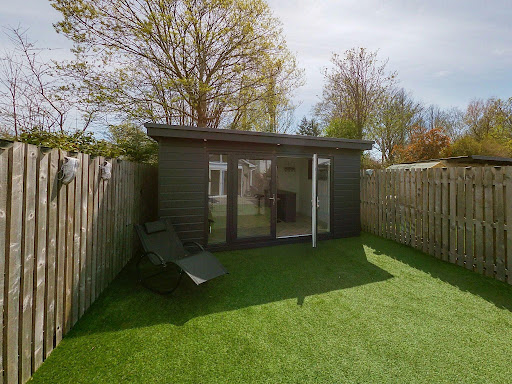
LONDON, UK. October 30th, 2026 – Homeowners installing a garden office can stay within planning limits and still end up in a dispute with the neighbours, UK garden building manufacturer Garden Buildings Direct has warned.
The warning comes as hybrid working remains common. The Office for National Statistics reported that 28% of working adults in Great Britain were hybrid working between January and March 2025. Separately, research published by Confused.com in July 2026 found that one in 10 UK homeowners and renters have disagreements with their neighbours at least once a month.
Garden Buildings Direct said the risk lies in assuming that a building which meets the permitted development rules will not cause problems next door.
James Rice, garden buildings expert at Garden Buildings Direct, said: “Most garden office disputes do not begin with the office itself. They begin when a building affects the property next door through its height, position, windows, lighting or drainage. Meeting the permitted development rules is important, but it does not automatically make every design neighbour friendly. A garden office can remain within the planning limits and still cause tension if it blocks light, overlooks a private garden or becomes difficult to maintain without entering someone else’s property.”
Under permitted development rules in England, an outbuilding within two metres of a boundary can be no more than 2.5 metres high. The allowances do not apply to flats or maisonettes, any outbuilding within the curtilage of a listed building requires planning permission, and further restrictions apply on designated land such as conservation areas and national parks. The company advises homeowners to check with their local planning authority before installation, which it said is far easier than altering or removing a building after a complaint.
Position is another concern. There is no general rule requiring a garden office to sit a set distance from a wooden fence, but the company said a building placed tight against a boundary can leave no room for guttering, timber treatment and future repairs, and access through a neighbouring garden cannot be assumed. Large windows facing next door can also leave neighbours feeling overlooked. Frosted glazing, blinds or repositioned windows can protect privacy without sacrificing natural light.
The company also highlighted drainage and daylight. Rainwater should drain within the property rather than flow into the neighbouring garden, so guttering and drainage need planning before installation, particularly when a roof slopes towards a boundary. A building within the height limit can still feel imposing beside a neighbouring patio, window or seating area, and moving it slightly or choosing a lower roof may make a significant difference.
Everyday use can cause friction too, including outdoor lighting, calls on speakerphone and doors opening and closing early in the morning. The company recommends pointing external lights downwards and away from nearby windows, keeping calls inside, closing windows during louder meetings and using the office at reasonable hours.
Some projects carry formal obligations. Building on or at a boundary, work on a party wall, or excavating near a neighbouring building and below its foundation level may fall under the Party Wall etc. Act 1996, which applies in England and Wales. Even where no formal notice is required, the company recommends explaining the plans and likely installation dates beforehand.
Confused.com’s research reported that 61% spoke directly with their neighbour over a dispute, while 18% called the local council to report them.
Rice added: “Speaking to the neighbours does not replace planning permission or any formal notice that may be required, but it can prevent misunderstandings. Sharing the proposed position, height and installation dates gives them an opportunity to raise practical concerns before the work begins. A small adjustment at the planning stage could be much easier and less expensive than dealing with a complaint once the garden office is already in place.”
ENDS