
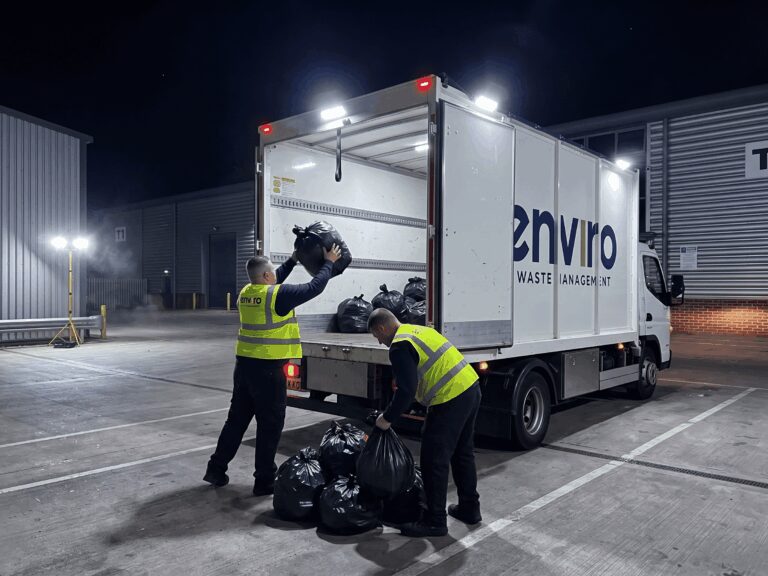
Operational changes remove unnecessary overnight dustcart usage and improve collection efficiency.
LONDON, UK. May 26th, 2026 – Enviro Waste Management has introduced a new operational approach designed to reduce fuel consumption and improve fleet efficiency by removing unnecessary overnight dustcart usage from its sack collection services.
The company previously used dustcarts across both daytime bin collections and overnight sack collection routes, with sack collections taking place between 12am and 6am.
Following an internal operational review, Enviro Waste Management has now transitioned overnight sack collections onto smaller collection vehicles, while reserving dustcarts exclusively for daytime bin collection operations.
The change means large refuse vehicles are no longer being operated continuously across both day and night shifts.
For waste operators, fuel consumption remains one of the largest operational costs across collection services, particularly for heavy vehicles operating within urban environments. Large refuse collection vehicles consume substantially more fuel than smaller transport alternatives due to their weight, stop-start routing patterns and onboard compacting systems.
As fuel prices and operational costs continue to rise across the industry, many waste companies are increasingly reviewing fleet structures and route planning to identify opportunities for greater efficiency without compromising service reliability.
Enviro Waste Management says the operational review was driven by a wider assessment of how vehicle allocation could be improved across different collection types and time periods.
According to the company, the restructure significantly reduces fuel usage and unnecessary energy consumption without affecting customer collections.
“Dustcarts are essential for larger bin collection operations, but they also consume significantly more fuel due to their size and onboard systems,” said John Kinful, Operations Manager at Enviro Waste Management.
“When we reviewed our overnight sack collections, it became clear that smaller vehicles could complete the same work far more efficiently.”
Reducing unnecessary heavy vehicle usage
Unlike standard vans or smaller trucks, dustcarts require additional energy to operate hydraulic systems and compacting equipment throughout collection routes.
By removing dustcart usage from overnight sack collections, Enviro Waste Management expects to reduce overall fleet fuel consumption, minimise unnecessary engine operation, improve route efficiency, produce lower operational emissions and extend the operational lifespan of heavy collection vehicles.
The company says the operational adjustment forms part of a broader focus on improving efficiency through practical logistics decisions rather than headline sustainability claims.
Smarter operational planning
Rather than relying solely on carbon offsetting or environmental claims, Enviro Waste Management says the focus is on identifying practical operational improvements that reduce waste across the business itself.
The company believes small logistical decisions can collectively have a meaningful impact on fuel usage, efficiency and environmental performance over time.
The company also says operational sustainability is becoming increasingly important for customers looking to work with suppliers that can demonstrate measurable efficiency improvements rather than broad environmental statements alone.
By restructuring collection methods and reducing unnecessary heavy vehicle usage, Enviro Waste Management believes waste operators can improve both operational performance and environmental impact simultaneously.
The company has also introduced more structured sack delivery scheduling for certain customers to reduce repeat journeys and improve logistical efficiency across multi-site operations.
“We’re constantly reviewing how we operate day to day,” added John.
“Sometimes the smarter decision is simply using the right vehicle for the right job. Small operational improvements can create meaningful reductions in fuel usage over time.”
ENDS