
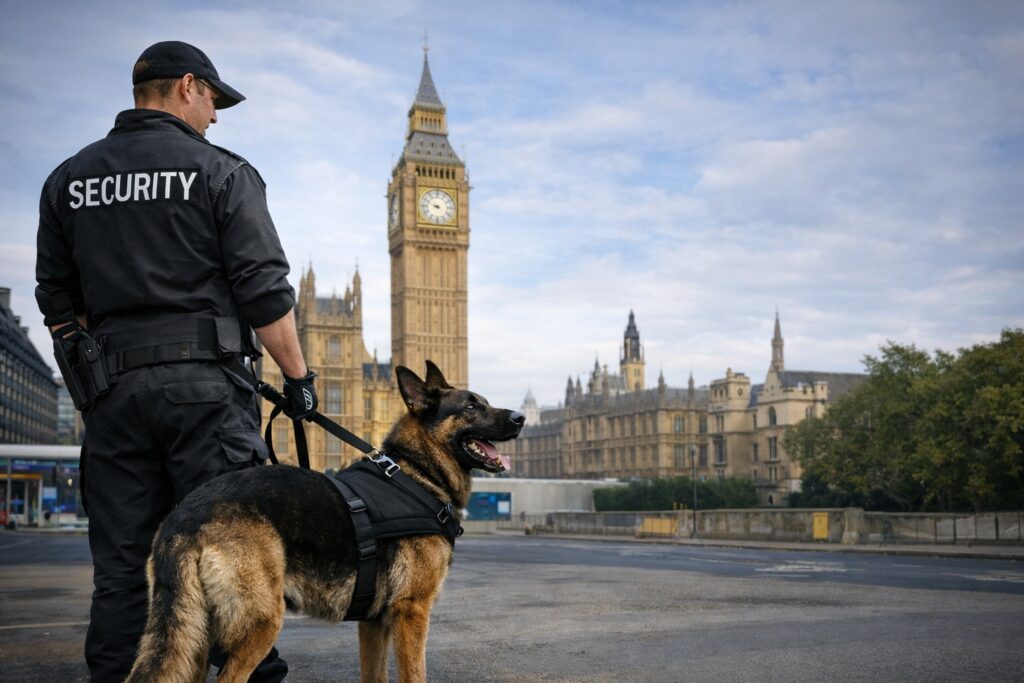
London, UK – Campaign for Security Industry Reform is calling for security dog handling to be brought within the formal regulatory framework of the Security Industry Authority (SIA), closing a clear gap in oversight, safety, and professional standards.
Security dog handling currently sits in a regulatory grey area. Handlers are licensed only as general security operatives, while dogs are treated as ancillary tools rather than trained working animals integral to operational decision-making and risk control. This lack of formal recognition fails to reflect the complexity, responsibility, and risk associated with deploying dogs in live security environments.¹
Regulatory gap leaves risks unchecked
Under current arrangements, the SIA does not licence security dog handling as a distinct specialism. As a result, individuals may legally work with security dogs without holding recognised dog-handling qualifications. This creates inconsistent standards across the sector and exposes the public, handlers, clients, and the animals themselves to avoidable risks.¹
Security dogs act as deterrents, detection assets, and protective partners. Yet there is no statutory assurance of consistent standards covering training, control, welfare, veterinary fitness, operational deployment, or post-incident accountability. Existing voluntary British Standards, including BS 8517-1 and BS 8517-2, provide robust guidance on handler competence and animal welfare, but compliance is not mandatory and cannot be enforced by the SIA.¹
Training and professional standards already exist
Many professional handlers hold qualifications from established bodies such as the National Association of Security Dog Users (NASDU), the National Training Inspectorate for Professional Dog Users (NTIPDU), or the National Security & Civilian Training Organisation (NSCTO). These schemes typically require formal training, written assessments, ongoing evaluation, and re-licensing, often exceeding the requirements placed on many front-line licensed security roles.¹
However, participation in these schemes remains voluntary. This allows less professional operators to avoid recognised benchmarks entirely, despite working in high-risk settings involving trained animals and public interaction.
Call for action
Campaign for Security Industry Reform urges the SIA and the Home Office to:
- formally recognise security dog handling as a licensed specialist role
- mandate accredited training and competence standards
- introduce statutory inspection and enforcement across the sector
- align regulation with fair pay and employment standards to retain skilled professionals.¹