
NOTTINGHAM, UK – 6th March 2026 – To mark World Lymphoedema Day 2026, PhysioPod® UK Limited has released the findings of an independent service evaluation: “Phase 1 Analysis: UK Treatments & Experiences of Head and Neck Lymphoedema (HNL).”
Moving beyond general awareness, this year’s initiative illuminates the specific, often invisible struggles of Head and Neck Cancer survivors living with secondary lymphoedema.
Between October and December 2025, the evaluation captured a “real-world snapshot” of the treatment landscape, analysing feedback from 84 respondents, including NHS professionals (50%), private practitioners (31%), and patients (19%).
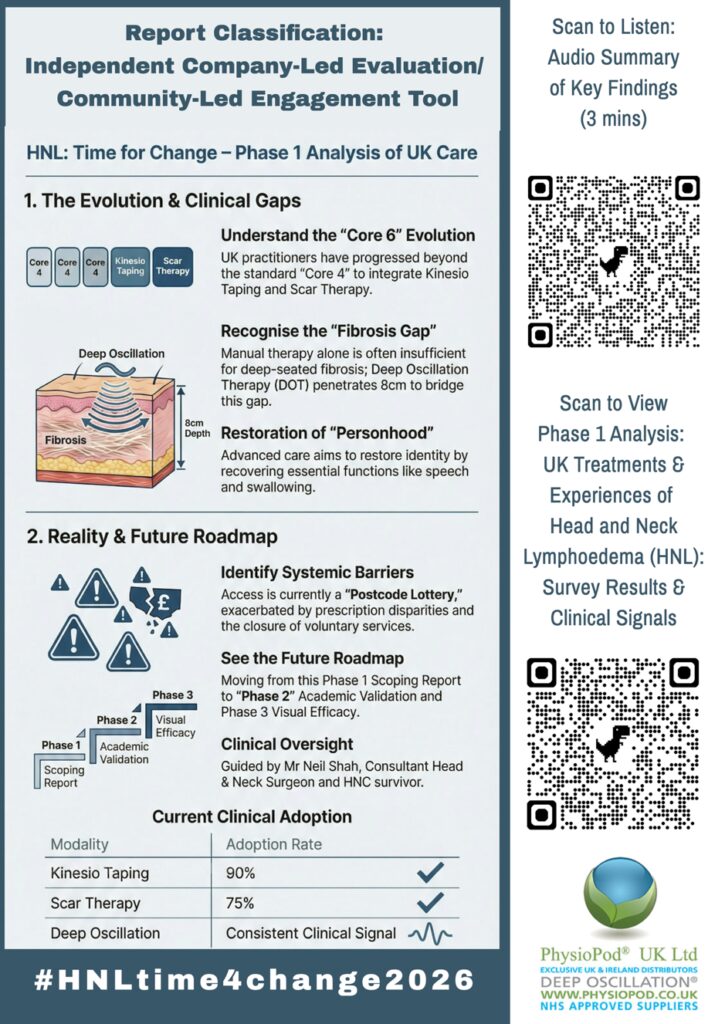
The data reveals that the traditional “Core 4” standard of care (Manual Lymphatic Drainage, Compression, Skin Care, Exercise) has expanded to the “Core 6” out of necessity. To meet the complex needs of HNL patients, practitioners are actively broadening their toolkits.
The survey found that 90% of practitioners now utilise Kinesio Taping and 75% integrate Scar Therapy, suggesting these have effectively become standard interventions alongside the original four.
In specialist centres, the evaluation noted the increasing integration of Photobiomodulation (Laser) and Negative Pressure Therapy (e.g., LymphaTouch) to address complex scarring and trismus (lockjaw).
A critical finding of the report is the identification of a “Fibrosis Gap” – the struggle to manage the “woody,” radiation-induced fibrosis that characterises HNL. NHS professionals and private practitioners frequently reported that standard Manual Lymphatic Drainage (MLD) alone is often insufficient for these deep tissue changes.
In contrast, the DOT Group (practitioners and patients utilising Deep Oscillation Therapy) reported consistent observations of “significant softening” of indurated tissue. This clinical signal aligns with the modality’s mechanism of action, which permeates tissue to a depth of 8 cm. The data suggests that this electrostatic technology successfully bridges the gap by addressing deep-seated resistance that manual techniques cannot reach, facilitating rapid improvements in range of motion.
The evaluation also highlights that reducing swelling in the head and neck is about more than just volume; it is about identity. Patients reported that the softening of fibrosis achieved through these adjunctive technologies was key to restoring “Personhood” – the recovery of essential social functions such as speech, swallowing, and smiling.
Despite these clinical advancements, the report validates severe systemic inequity. Data confirmed a “postcode lottery” in care, with many patients unable to access specialist services or essential head-and-neck compression garments via the NHS.
Consultant Head & Neck Surgeon Mr Neil Shah has described these findings as “strong signals” of unmet need that justify immediate action.
Consequently, this Phase 1 service evaluation has successfully triggered the planning of a formal Phase 2 Research Initiative. Led by Mr Shah, this next stage will utilise clinically validated measures, such as the Glasgow Benefit Inventory, to translate grassroots signals into robust, peer-reviewed evidence to challenge the status quo.
The full Phase 1 Analysis, including detailed breakdowns of the “Core 6” evolution and practitioner and patient open text feedback, is available to download from the PhysioPod® UK website.
ENDS