
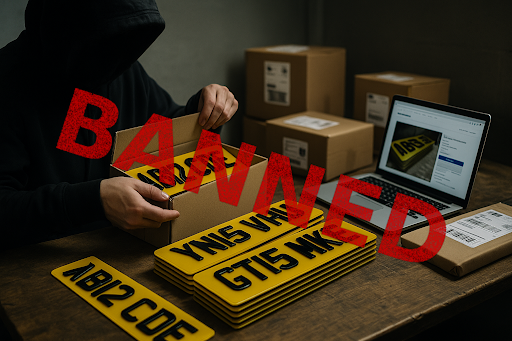
SWANSEA, UK. December 11th 2025 – A new proposal to amend the British Standard for number plates, BS AU 145e, has triggered urgent concern across the automotive industry sector as experts warn the ban could increase the circulation of illegal plates.
The draft amendment, now open for public consultation with the British Standards Institution (BSI), would prohibit 4D and gel-style number plates from regulated sellers and require all outward-facing surfaces to be completely flat.
Industry leaders are warning that removing these compliant products from legitimate suppliers could push motorists towards unregulated online sellers.
These sellers already play a significant role in the supply of illegally cloned, unreadable and untraceable number plates.
Antony Clark of VRM Swansea, Plates4Less, established private number plate agent, commented:
“We fully support any measure that improves road safety and reduces number plate fraud, but changes must be guided by real evidence. When produced using compliant materials and correct processes, 4D and gel plates meet the legal standard and do not cause ANPR issues. If anything, raised characters make registrations easier to read and remember.”
Reports from police forces show a steady rise in plate-related crime, including cloning and ANPR evasion, and many cases involve plates purchased from illegal or unregistered retailers.
With fears that restricting compliant businesses could further expand this underground market at a time when enforcement teams are already under pressure.
“A blanket ban risks pushing customers towards unregulated sellers and online marketplaces where illegal plates are already a major problem. The priority should be enforcing existing rules and tackling rogue traders, not removing legitimate products from compliant businesses.” Antony added.
The consultation remains open until 13th December 2025, leaving a limited window for manufacturers, enforcement bodies and motorists to submit evidence.
Increased public attention on number plate crime has recently highlighted gaps in the monitoring and prevention of vehicle identity fraud, with Members of Parliament calling for wider reforms to strengthen the registration system and protect motorists.
A cross-government inquiry published this week reported that up to one in fifteen vehicles may now display illegal or unreadable plates designed to evade ANPR detection, according to evidence presented to the All-Party Parliamentary Group for Transport Safety (APPGTS).
In addition, a BBC investigation reported a sixty-four percent rise in vehicle cloning cases in London between 2021 and 2023, increasing from 22,450 to 36,794 cases over the two-year period.
Customer insight data from Plates4Less shows that 4D and gel plates have risen sharply in popularity and now represent up to a quarter of new plate sales.
Motorists surveyed stated that they select these designs for both appearance and enhanced legibility.
No test data has been presented to demonstrate that compliant 4D or gel plates cause ANPR detection problems, with illegal or altered plates remaining the primary source of failure.
Stakeholders note that removing compliant raised-style products from the market may push consumers towards unregulated sellers that already bypass RNPS requirements.
Legitimate suppliers could face commercial restrictions not applied to illegal operators, while motorists would lose access to popular plate styles that make up a substantial portion of current sales.
Experts argue that more effective alternatives exist, including increased enforcement against illegal traders, improved digital compliance tools, clearer RNPS guidance, stronger traceability for plate components and increased penalties for displaying illegal number plates.
The draft amendment would prohibit raised characters over 2 mm, the attachment of any materials to the outward-facing surface including 4D or gel elements, any layered or non-flat construction, and the use of overlays or applied materials that alter surface flatness.
If enacted, the change would prevent the legal manufacture of all raised-style number plates.
While previous changes to number plate standards have not required motorists to replace their existing plates, it is not yet confirmed whether that approach would apply again.
Based on current sales volumes, up to 25 percent of motorists who purchased plates in the past five years could be affected if retrospective compliance were introduced.
The BSI is inviting comments from manufacturers, RNPS holders, retailers, motorists, trade bodies, ANPR specialists and enforcement organisations. Submissions can be made through the consultation portal.
Responses may also be emailed using the BSI template to admin.start@bsigroup.com. Further background information and a public Q&A are available at Plates4Less and Additional information on number plate formats.
ENDS